

Pomodoro Technique vs. Deep Work: Which Method is Right for You?
Discover the differences between the Pomodoro Technique and Deep Work. We compare both time management methods, show their pros and cons, and help you choose the right strategy for your work style.

Introduction: Two Paths to Productivity
You're sitting at your desk and wondering: Should I work in short sprints or concentrate fully for longer periods? Many people ask themselves this question when they want to improve their productivity. The Pomodoro Technique and Deep Work are two of the most popular time management methods – but which one is really right for you?
Both approaches have millions of followers worldwide, but they work according to completely different principles. While one method relies on frequent breaks, the other focuses on uninterrupted focus blocks. In this article, we compare both techniques, show you their strengths and weaknesses, and help you make the right choice for your work style.
The Pomodoro Technique: Working in Short Sprints
How the Pomodoro Technique Works
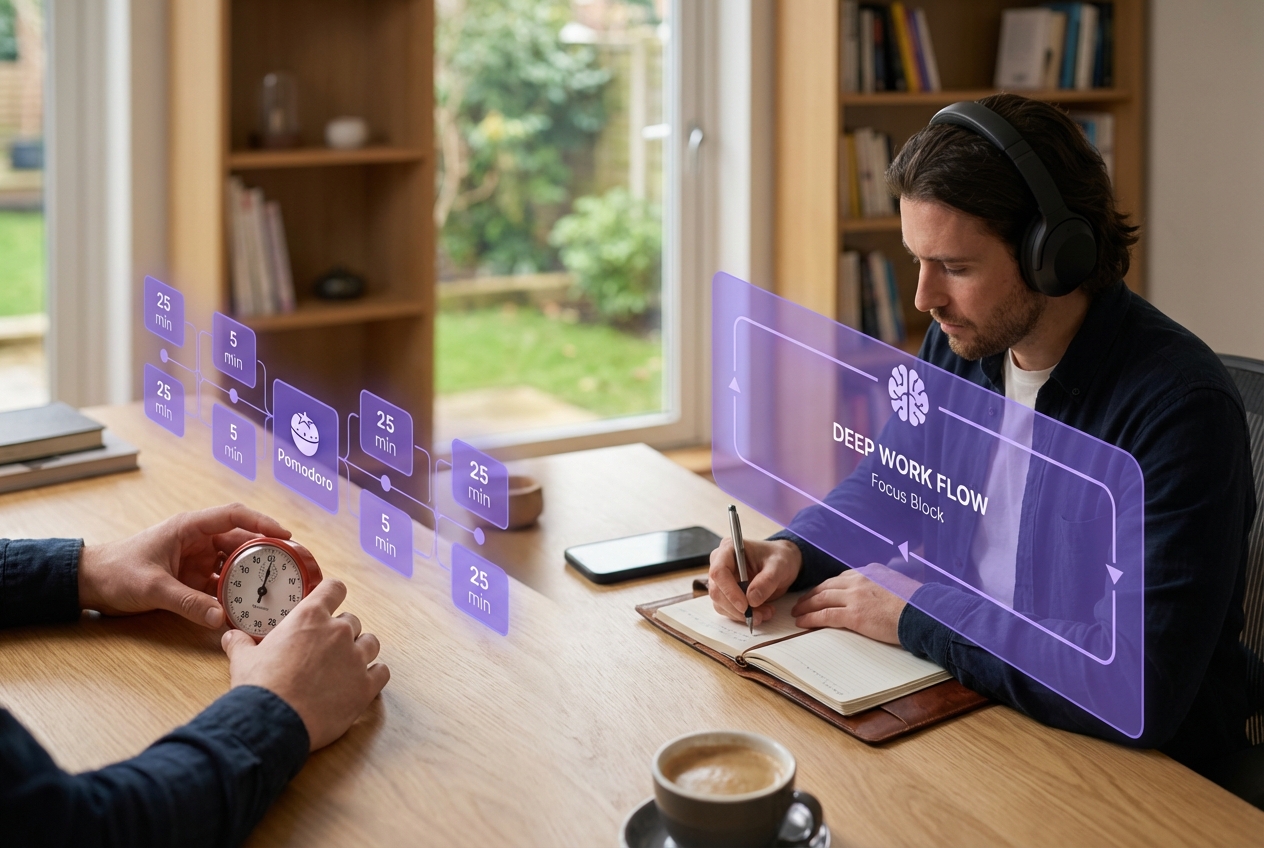
The Pomodoro Technique was developed in the 1980s by Francesco Cirillo and is named after the tomato-shaped kitchen timer (Italian: Pomodoro = tomato) that he used as a student. The principle is simple and elegant:
- Work for 25 minutes focused on one task
- Take a 5-minute break
- After four pomodoros (a total of 2 hours), take a longer break of 15-30 minutes
- Repeat the cycle
The concept is so popular because it's psychologically effective. The limited time creates a slight pressure that keeps you focused without overwhelming you. You know exactly that a break is coming in 25 minutes – that makes it easier to resist distractions.
Advantages of the Pomodoro Technique
Prevents burnout: Regular breaks ensure that you don't reach a state of complete exhaustion. Your brain gets time to recover.
Reduces procrastination: 25 minutes feels manageable. Even with difficult tasks, it's easier to start when you know a break is coming soon.
Improves time awareness: You develop a sense of how long tasks actually take. This helps with more realistic daily planning.
Promotes regularity: The structured breakdown creates routine. With tools like Planpilot, you can even integrate these breaks automatically into your daily schedule.
Disadvantages of the Pomodoro Technique
Interrupts flow: Just when you're getting into a productive rhythm, the 25-minute limit stops you. This is especially frustrating for complex tasks that need more warm-up time.
Too rigid for some tasks: Not all work fits into 25-minute blocks. An important client call or creative session can't simply be interrupted.
Can be fragmenting: For large projects, constant division can be counterproductive. You spend more time on transitions than on actual work.
Deep Work: Deep Concentration for Complex Tasks
What is Deep Work?
Deep Work is a concept that Cal Newport coined in his book of the same name. It describes the ability to concentrate on a cognitively demanding task without distraction. Unlike the Pomodoro Technique, this is about long, uninterrupted work phases – typically 3-5 hours or more.
Deep Work is based on the idea that true mastery and innovation only emerge when you fully dedicate yourself to a task. Your brain needs time to work deeply, and constant interruptions destroy this state.
Advantages of Deep Work
Enables true flow: When you can work uninterrupted for 2-3 hours, you reach the famous "flow state" – that state of complete absorption where time flies and your best work happens.
Higher quality: Complex problems require deep thinking. Deep Work allows you to understand connections and find truly innovative solutions.
Fewer transition losses: Every time you switch tasks, your brain needs time to reorient. With Deep Work, you minimize these transition losses.
Better results in less time: Paradoxically, you can achieve better results with less, but more concentrated work time than with many fragmented hours.
Disadvantages of Deep Work
Hard to establish: The modern workplace is full of interruptions – emails, meetings, notifications. Creating Deep Work requires active boundary-setting and often negotiations with colleagues and supervisors.
Not suitable for everyone: Some people can't concentrate for 4 hours without needing a break. That's not laziness – it's simply a matter of neurobiology.
Can lead to overwork: Without the built-in breaks of the Pomodoro Technique, it's easy to fall into a state of exhaustion without noticing.
Less flexible: If you're frequently interrupted (e.g., in customer service roles), Deep Work is hardly feasible.
Comparison: Which Method Fits Your Work Style?
Choose Pomodoro if...
- ...you have many different tasks and frequently switch between them
- ...you struggle to concentrate and need regular breaks
- ...you procrastinate and smaller goals are motivating
- ...your work is interrupted (meetings, calls, requests)
- ...you're at the beginning of your productivity journey and need simple structure
Choose Deep Work if...
- ...your work requires deep concentration (programming, writing, design, analysis)
- ...you can maintain long focus phases
- ...you have control over your time and can minimize meetings
- ...you notice that interruptions significantly impact your work
- ...quality is more important than quantity
The Best Solution: A Combination of Both Methods
The good news: You don't have to choose just one method. Most successful people intelligently combine both approaches.
Hybrid Approach for Maximum Efficiency
Deep Work blocks with Pomodoro structure: Plan your week so that you reserve 2-3 days for Deep Work sessions. On these days, you work in 3-4 hour blocks. On other days, when more meetings and interruptions occur, you use the Pomodoro Technique for smaller tasks and administrative work.
Example of a hybrid daily schedule:
- 8:00-11:00 AM: Deep Work (complex project, no interruptions)
- 11:00-11:30 AM: Break
- 11:30-12:00 PM: Pomodoro 1 (answering emails)
- 12:00-12:05 PM: Short break
- 12:05-12:30 PM: Pomodoro 2 (administrative tasks)
- 12:30-1:30 PM: Lunch break
- 1:30-3:30 PM: Deep Work (continuation of project or new project)
- 3:30-4:00 PM: Breaks and meetings
- 4:00-4:25 PM: Pomodoro 3 (tidying up, planning for tomorrow)
Practical Tips for Combining Both
Use the right time of day: Some people are most focused in the morning – that's the best time for Deep Work. Use afternoons for Pomodoro phases when your concentration dips.
Protect your Deep Work time: Turn off notifications, close your email, let colleagues know you're unavailable. With an app like Planpilot, you can mark your Deep Work blocks as "focused time" in your calendar.
Use Pomodoros for transitions: Between Deep Work blocks, short Pomodoro breaks are ideal for moving around, drinking water, or quickly handling administrative tasks.
Be flexible: Not every day is the same. Some days you need more structure, others more flexibility. The best method is the one you can actually apply.
Practical Implementation: How to Get Started
Step 1: Recognize Your Tasks
Categorize your daily tasks:
- Deep Work tasks: Require deep concentration and longer time (e.g., project development, writing, analysis)
- Pomodoro tasks: Smaller, interruption-tolerant tasks (e.g., emails, administration, simple meetings)
- Flexible tasks: Can be handled with either method
Step 2: Plan Your Week
Reserve fixed Deep Work blocks in your calendar. Treat them like important meetings – they're non-negotiable. Use the remaining time for Pomodoro phases and meetings.
Step 3: Experiment and Optimize
Try different combinations. Maybe you need 90-minute Deep Work blocks instead of 3 hours. Maybe 30-minute Pomodoros work better for you than 25. The key is finding what works for you personally.
Avoiding Common Mistakes
Mistake 1: Being too rigid. If a method isn't working, switch it. Productivity is not a one-size-fits-all solution.
Mistake 2: Ignoring breaks. No matter which method you choose – breaks are not optional. They're what keeps you productive.
Mistake 3: Changing too much at once. Don't try to overhaul your entire work style overnight. Implement one method for a week, then the other. That way you'll see what works.
Mistake 4: Tools before strategy. It's tempting to invest in a new app or gadget. But the best productivity app is only as good as your discipline. Start with pen and paper if necessary.
Conclusion: Find Your Personal Productivity Formula
There is no universal best method – there's only the best method for you. The Pomodoro Technique and Deep Work are both effective, but for different situations and people.
The Pomodoro Technique gives you structure, regularity, and prevents burnout. Deep Work allows you to achieve true mastery and solve complex problems. And the best part: You don't have to choose. Combine both methods into a hybrid strategy that fits your work style.
The first step is simple: Choose a method that appeals to you and try it for a week. Observe how your productivity changes. After one week, you'll already know much more about your personal preferences.
Remember: True productivity isn't about doing more – it's about doing the right things. Whether you achieve that with Pomodoros, Deep Work, or a mix of both matters less than the consistency and intentionality with which you use your time.
Bereit, deinen Tag zu planen?
Probiere die Zeitbox-Methode mit Planpilot aus — kostenlos und in 5 Minuten einsatzbereit.
Jetzt kostenlos starten →

Comments
Leave a comment
Please follow our . Comments are published after review.