

Overcoming Procrastination: How to Conquer Your Inner Block with Micro-Tasks
Procrastination is a major productivity killer. Learn how to break down large tasks into small micro-tasks and overcome your inner resistance. With practical strategies and Planpilot, you can start making progress today.
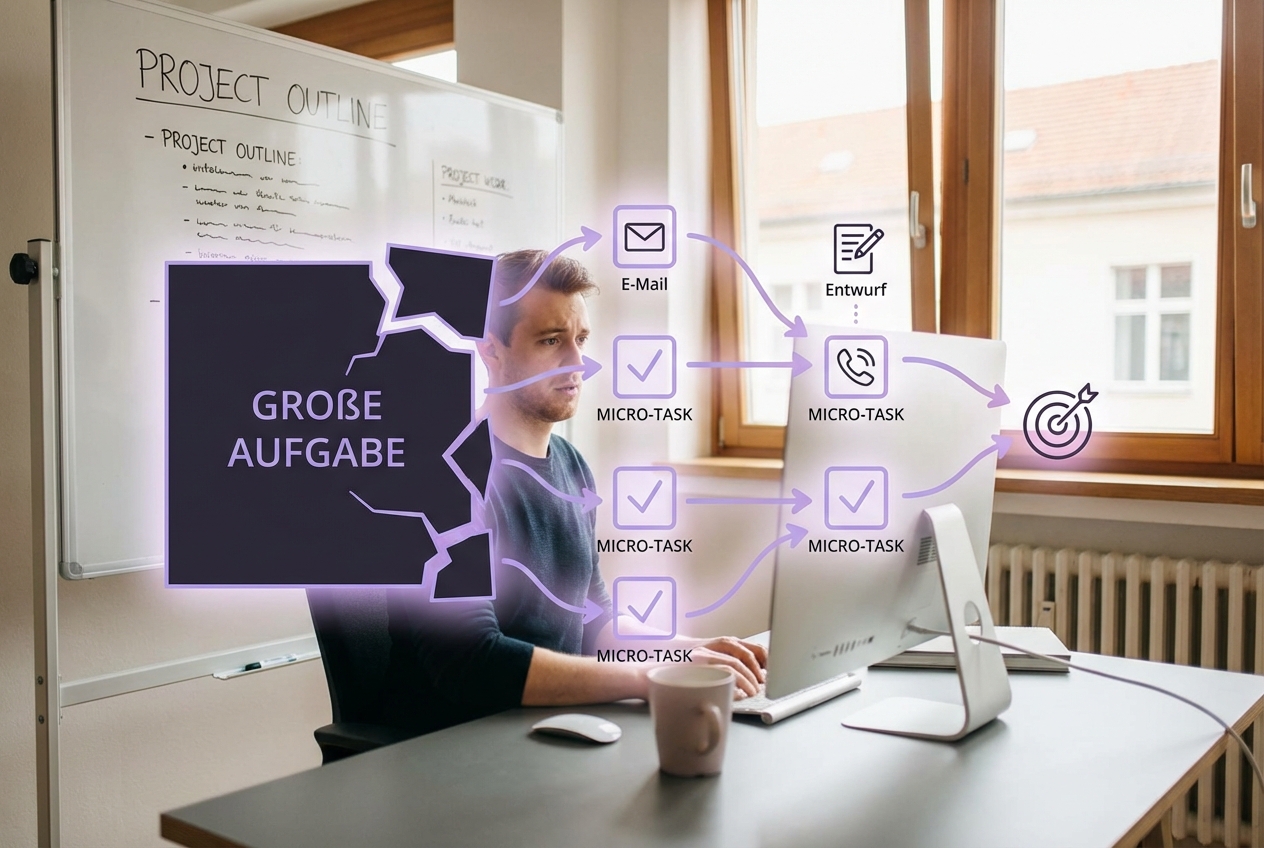

Why You Procrastinate – And It's Not Your Fault
You sit down in front of a big task and immediately feel that paralysis. The project is too large, too complex, too overwhelming. So instead, you open Instagram, check your emails, or tidy up your desk – anything but the task itself. That's procrastination, and you're not alone in it.
Procrastination isn't simply laziness. It's an emotional regulation disorder. Your brain is trying to protect itself from uncomfortable feelings – fear of failure, uncertainty, or simply being overwhelmed by the size of the task. The larger and more complex a task appears, the stronger the impulse to avoid it.
The good news: There's a proven strategy against it. And it's surprisingly simple.
The Micro-Task Strategy: Small Steps, Big Success
The solution is called micro-tasks. The concept is elegant: You break down large, intimidating tasks into tiny, concrete steps that you can complete in 5 to 15 minutes.
An example: Instead of "finish presentation," you write down:
- Slide 1: Add title and outline (5 min)
- Slides 2-4: Write introduction (10 min)
- Slides 5-8: Insert graphics (15 min)
- Slides 9-12: Edit text (10 min)
- All slides: Adjust formatting (10 min)
Suddenly, the presentation is no longer a massive mountain, but a series of small, manageable chunks. Your brain relaxes. The block disappears. You can start.
Why does this work so well? Because micro-tasks lower the psychological barriers:
- They feel less overwhelming: 5 minutes feels doable, 3 hours doesn't.
- You see quick wins: Every completed micro-task is a victory that rewards your brain with dopamine.
- You build momentum: Once you've started, it's easier to keep going.
- The task becomes concrete: Instead of vague planning, you know exactly what needs to be done.
How to Properly Break Down Tasks into Micro-Tasks
Breaking down tasks is a skill you can learn. Here are concrete steps:
Step 1: Write Down the Big Task
Be specific. Not "do project X," but "create project plan for Q2 and send to boss."
Step 2: Think About the Sequence
In what order do things need to happen? Sometimes you need to research before you can write. Sometimes you need to get feedback before you finalize. Write down this logical sequence.
Step 3: Break Down Each Step Further
If a step takes longer than 15 minutes, it's still too big. Break it down further. "Conduct research" becomes "read 3 articles on topic X" and "gather 5 data points."
Step 4: Add Time Estimates
How long will each micro-task realistically take? Write it down. This helps you plan later and gives you a sense of your pace.
A practical example: You need to write a report.
- Create outline (5 min)
- Chapter 1: Write introduction (10 min)
- Chapter 2: Gather data (15 min)
- Chapter 2: Write analysis (15 min)
- Chapter 3: Formulate recommendations (10 min)
- Proofread entire text (10 min)
- Formatting and images (10 min)
Suddenly, what was a large, undefined project has become a clear action plan with 75 minutes of work. That's motivating, not discouraging.
Integrate Micro-Tasks into Your Daily Routine
Breaking down tasks is only the first step. The second is actually completing these micro-tasks. Here are proven strategies:
Use Timeboxing
Give each micro-task a fixed time window. Not "sometime today," but "from 2:00 to 2:15 PM." This creates accountability and prevents you from getting scattered.
Start with the Smallest Task
This is psychologically clever: If you start with a 5-minute task and complete it, you've already had a win. The momentum helps you tackle the next task. This is called the "Two-Minute Rule" – if something takes less than two minutes, do it immediately.
Take Breaks Between Tasks
After each micro-task: take a short break. 2-3 minutes. Drink water, stand up, take a deep breath. This prevents burnout and keeps your focus sharp.
Visualize Your Progress
Use a checklist or an app like Planpilot to check off your completed micro-tasks. Every checkmark is psychologically valuable – it shows you that you're making progress.
Practical Tips for Chronic Procrastinators
Some people have particular difficulty getting started. If that's you, try these techniques:
The 2-Minute Rule
Commit to working for just 2 minutes. That's so little that it requires no real effort to overcome. Usually, after 2 minutes, you realize it's not so bad and keep going. But even if you don't – 2 minutes is better than 0 minutes.
The "If-Then" Planning
Link your micro-task to an existing routine: "If I've finished my coffee, then I'll write down the first micro-task." These if-then statements make it easier to start because your brain automates the routine.
Eliminate Distractions
Put your phone in another room. Close browser tabs. Message colleagues that you're unavailable. The fewer distractions, the easier it is to focus on the one micro-task in front of you.
Find Your Optimal Time
Some people are productive in the morning, others at night. Some need movement, others need quiet. Experiment. Once you know when you're most focused, schedule your most difficult micro-tasks for that time.
Connect Micro-Tasks to Your Daily Planning
Micro-tasks work best when they're part of structured daily planning. Here's a practical workflow:
- The evening before: Look at your big projects. Choose 2-3 you want to advance tomorrow.
- Break them down: Divide each project into micro-tasks. Write them down.
- Prioritize: Which micro-tasks are most important? Which do you need to do first?
- Schedule them: Assign your micro-tasks to your daily schedule. 9:00-9:15 AM: Task 1. 9:15-9:30 AM: Task 2. Etc.
- During the day: Work through your micro-tasks. Check them off when they're done.
- In the evening: Look at what you've accomplished. That's your victory for the day.
With an app like Planpilot, you can automate this process. You create your micro-tasks, set time windows, and the app reminds you when it's time to start. This takes a lot of mental load off and helps you stay organized.
What You Should Avoid
When working with micro-tasks, there are also pitfalls:
- Too many micro-tasks at once: If your list has 20 tasks, it feels overwhelming again. Limit yourself to 5-7 per day.
- Unrealistic time estimates: If you plan a task for 5 minutes but need 20, you'll lose track. Be honest with yourself.
- Perfectionism: A micro-task doesn't need to be perfect. It just needs to move you forward one step. Accept "good enough."
- No breaks: If you do micro-tasks back-to-back for 8 hours, you'll burn out. Schedule real breaks.
Summary: Your First Step Today
Procrastination isn't something you simply have to "overcome." It's a signal that the task feels too big. The solution is elegant: Make it smaller.
Here's what you can do today:
- Write down a task you've been putting off.
- Break it into 5-7 micro-tasks, each taking 5-15 minutes.
- Choose the first micro-task.
- Give yourself 5 minutes – no more.
- Start.
That's all you need. No motivation, no big planning. Just one small, concrete task and 5 minutes of time.
If you use this process regularly and plan your micro-tasks in a structured way, you'll notice how procrastination loses its power over you. Not because you suddenly become more disciplined, but because tasks stop feeling overwhelming.
And that's the real victory against procrastination.
Bereit, deinen Tag zu planen?
Probiere die Zeitbox-Methode mit Planpilot aus — kostenlos und in 5 Minuten einsatzbereit.
Jetzt kostenlos starten →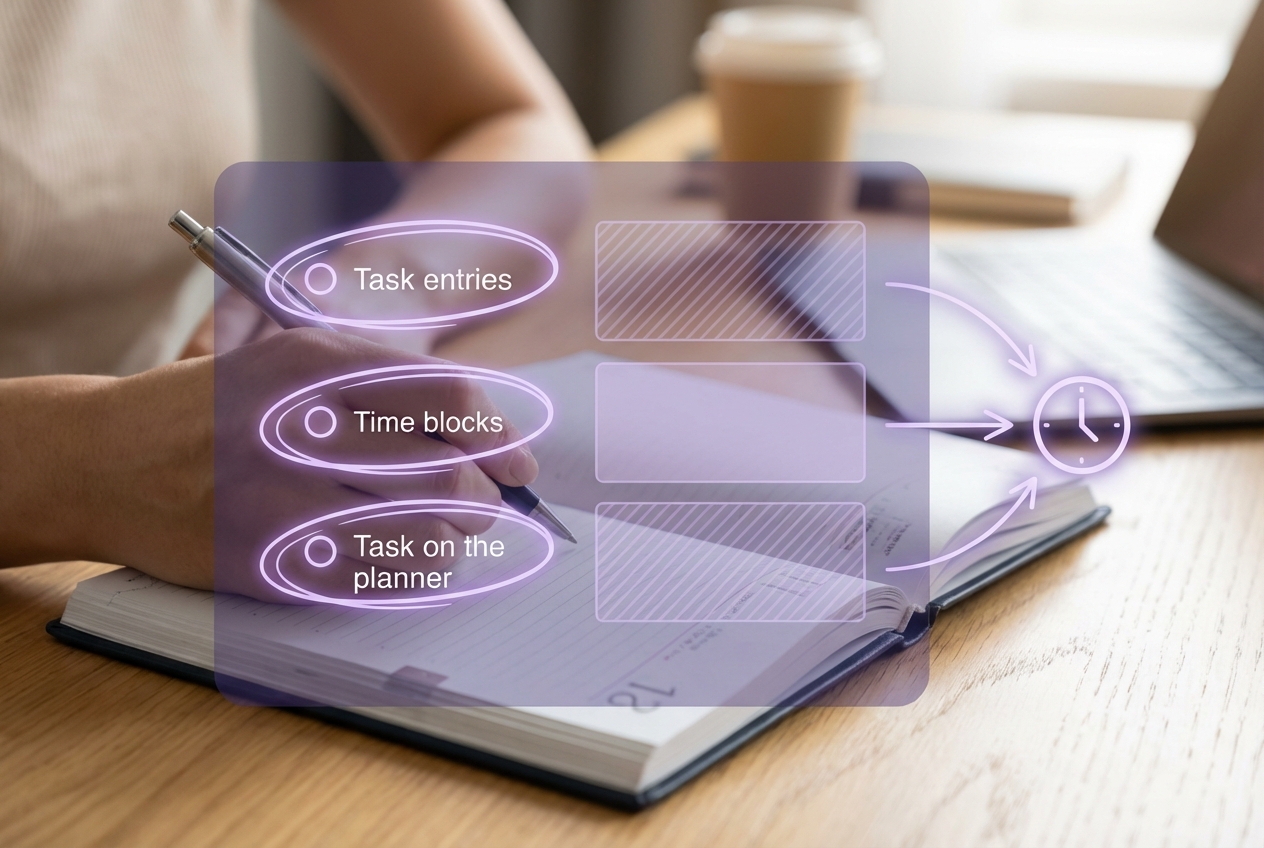
Comments
Leave a comment
Please follow our . Comments are published after review.